
How Much Should My Book Cost? A Strategic Guide to Pricing for Self-Published Authors
Pricing can make or break your book’s success. This article explores how to set the right price point based on goals, genre standards, global markets, and reader expectations — while still earning fair compensation.
SELF-PUBLISHINGBOOK PROMOTION & MARKETING
How Much Should My Book Cost? A Strategic Guide to Pricing for Self-Published Authors
Pricing a book is one of the most overlooked—but most important—decisions an author makes. A strong cover, solid editing, and smart marketing all matter, but if your price isn’t aligned with your goals and your market, you’re leaving money and readers on the table.
Traditional publishers know this. Before they acquire a manuscript, editors run detailed profit-and-loss (P&L) projections. They know exactly what price point a book needs to hit to be viable. Indie authors, by contrast, often pick a price based on guesswork, or worse, what “feels right.”
But here’s the truth: your price is part of your book’s positioning. It signals value, determines profitability, and directly impacts whether readers choose you over a competitor. Get it wrong, and you may struggle with sales no matter how good your book is.
Let’s break down how to approach pricing like a professional—without needing a publishing house behind you.
Step 1: Define Your Goals First
Not every author has the same definition of success. Before you decide on a price, ask: What’s my real goal for this book?
Maximize revenue per copy → Higher price point, lower volume, but strong profit margins.
Reach the widest possible audience → Lower price point, higher volume, potentially sacrificing profit for visibility.
Build credibility or authority → Pricing may be secondary; the goal is influence.
Create a keepsake or passion project → Aesthetic choices (hardcover, full color) may drive the price more than profit.
Too many authors assume all these goals align. They don’t. Knowing your primary goal helps you set a strategy that makes sense for your publishing journey.
Step 2: Research Your Market
Traditional publishers live and die by market research. You should too.
Here’s how to get reliable data:
Visit bookstores. Go to the section where your book would be shelved. Look at books with the same genre, trim size, and format. Write down their list prices.
Check online retailers. Amazon, Barnes & Noble, and Bookshop.org all list prices clearly. Pay attention to both indie and traditionally published titles.
Talk to booksellers and librarians. They know what price points actually move books.
Compare by format. Don’t compare your paperback to someone else’s hardcover. Trim size, binding, and page count all influence expectations.
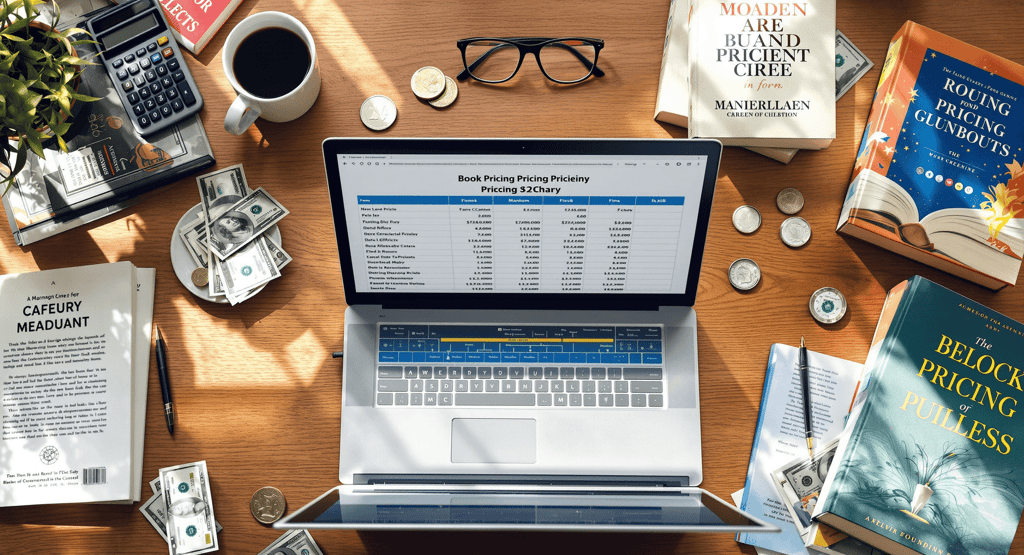
Pro Tip: Create a spreadsheet of 10–15 comparable books with price, format, page count, and publisher. This will give you a realistic “price band” for your book.
Step 3: Align With Reader Expectations
Readers have subconscious “price anchors.” If most memoirs in your category are $16.99–$18.99, and you price yours at $24.95, you’ve just created unnecessary friction.
That doesn’t mean you should always undercut—going too low can signal “cheap” or “low quality.” The sweet spot is often slightly under the average, just enough to catch attention without devaluing your work.
Step 4: Factor in Formats and Production Costs
The economics of your book matter. Pricing isn’t just about the market—it’s about whether you’ll earn enough per copy to meet your goals.
Key factors:
Trim size (6x9, 5.5x8.5, etc.) – Smaller sizes may lower print costs but may not match reader expectations in your genre.
Binding (hardcover vs. paperback) – Hardcovers can command higher prices, but only if your genre supports it.
Page count – Longer books cost more to print. Don’t assume you can price a 500-page book the same as a 200-page one.
Color vs. black-and-white – Full-color interiors (children’s books, art books, cookbooks) drastically raise print costs.
Use tools like IngramSpark’s Publisher Compensation Calculator to test scenarios. Adjust trim size, format, and retail price until you see a compensation level that fits your goals.
Step 5: Balance Profitability With Competitiveness
Here’s the tightrope:
Price too high → better margins, fewer buyers.
Price too low → more buyers, but thinner margins.
The key is to find a balance that makes sense for your business model. Some authors are thrilled making $1 per copy if it means selling 30,000 copies a year. Others prefer a smaller but more profitable readership.
Remember: your long-term income may depend more on volume and reader base than on maximizing profit per book.
Step 6: Consider Global Pricing
One of the most overlooked opportunities in self-publishing is global reach.
With platforms like IngramSpark and Amazon KDP, your book can be available in the U.S., U.K., Europe, Australia, and Canada instantly. But here’s the catch: if you don’t set prices in those markets, your book won’t sell there.
Check comparable prices abroad. A $16.99 paperback in the U.S. might need to be £12.99 in the U.K. or €14.99 in Europe.
Round wisely. End with .99 or .00. If your converter says €14.27, round to €14.99 to look professional.
Don’t ignore niche markets. Spanish-language novels should be priced for U.S. and European readers. Canadian pricing can open doors to libraries and academic institutions.
Global pricing isn’t extra work—but it expands your potential readership dramatically.
Step 7: Test, Adjust, Repeat
Book pricing isn’t one-and-done. Many indie authors adjust after launch based on real sales data.
Consider:
Introductory pricing. Launch slightly lower, then raise once reviews and momentum build.
Seasonal promotions. Temporary discounts for holidays or book launches can drive visibility without changing your “normal” price.
Market feedback. If your sales stall despite good reviews, price may be the culprit.
Common Mistakes to Avoid
Pricing too far outside the norm. Readers and booksellers hesitate when a book doesn’t look or cost like its peers.
Ignoring production costs. Selling at $9.99 sounds attractive until you realize you’re only earning $0.30 per copy.
Confusing goals. If you’re chasing volume, don’t optimize for margin. If you’re chasing prestige, don’t compete on price.
Forgetting the psychological factor. $14.99 feels significantly cheaper than $15.25, even if the difference is pennies.
Why Pricing Is More Than Numbers
Pricing isn’t just math—it’s strategy. It tells readers how to perceive your book: premium, accessible, collectible, or disposable. It shapes your profit margins and determines how wide your audience can grow.
For indie authors, the right price is the difference between a book that struggles to sell and one that finds its market.
Conclusion: Price With Intention
Don’t treat pricing as an afterthought. Treat it as a core part of your publishing strategy.
Start with your goals.
Research your market.
Align with reader expectations.
Use production costs and global pricing strategically.
Adjust as you learn.
Your price is more than a number on a barcode—it’s a message to your readers about the value of your work.
Ready to position your book strategically? At The Knowledge Hub, we help authors move beyond guesswork with publishing strategies designed to compete in today’s crowded market. From pricing to promotion, our workshops give indie authors the professional edge they need to succeed.